
This article introduces the concept of a ‘content creation strategy’ and how to use it to position your brand story for growth

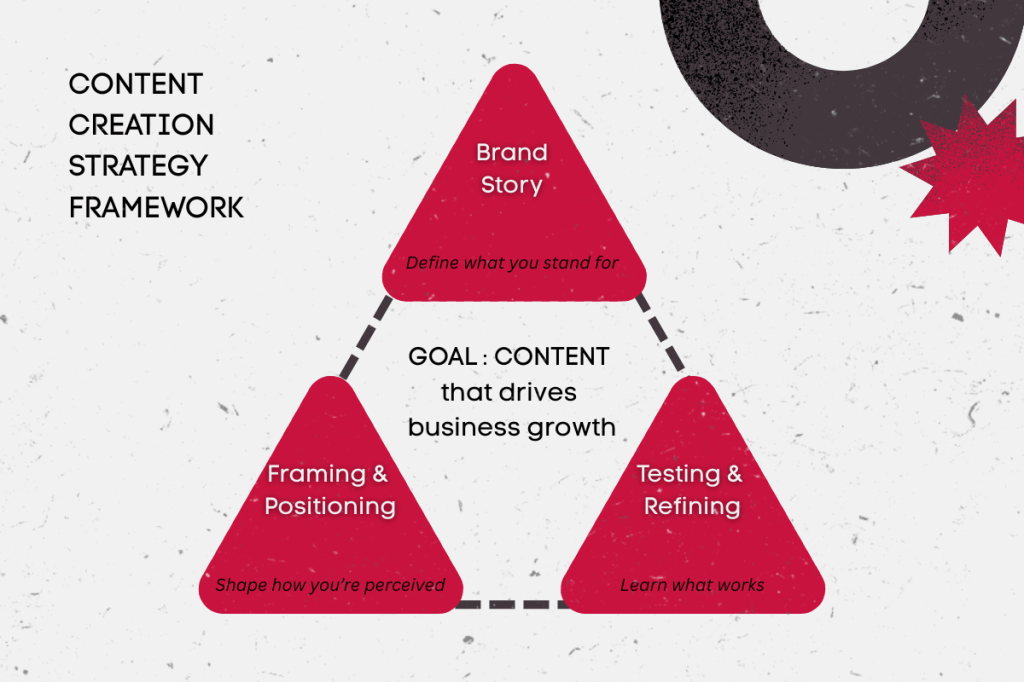
A content creation strategy is a process of testing and refining the most effective positioning of your sellable brand story. It requires three broad elements:
- A sellable brand story,
- Strategic positioning and framing of brand messaging, and
- Testing and refining (through content, distribution and measurement).
In earlier articles, I’ve covered how to find your sellable brand story and how to build a targeted messaging strategy. The third element – testing and refining – is where you test and refine that story in real markets. In this article, we’ll mainly focus on this third element of a content creation strategy.
- Why a Content Creation Strategy Matters
- Create a Content Plan
- Choose the Right Distribution Channels
- Set Performance Indicators
- Create, Test, Refine
- Refining the Story Through Strategy
Why a Content Creation Strategy Matters
Every business has stories. But how do you know if yours really connects? That’s where content creation strategy comes in. It’s the laboratory where brand stories and messages are tested, refined, and proven.
A strong content creation strategy aims to transform your brand story and positioning into consistent content that can be measured against business goals. It’s therefore the bridge between business strategy and content execution. It’s where brand storytelling becomes published marketing assets that aim to build awareness, credibility, and growth.
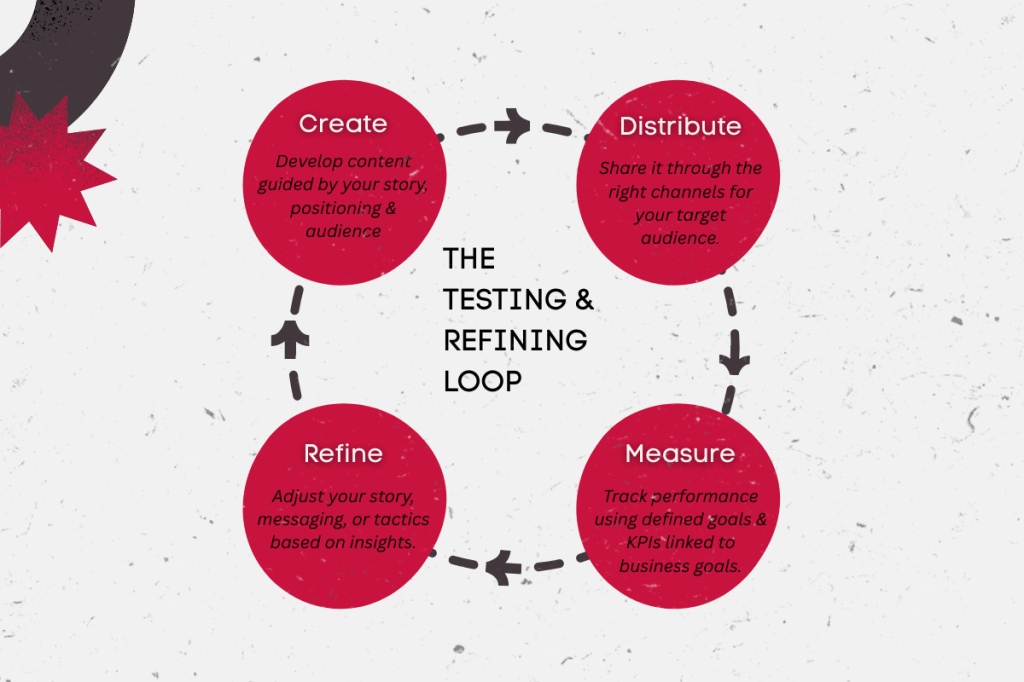
The testing and refining process connects three critical aspects: content creation, distribution channels, and measuring performance. These aspects must be considered together. There’s little point producing endless content without tracking its results or measuring channels without giving them something meaningful to measure.
In this guide, we’ll focus mainly on content creation, while showing how distribution and performance monitoring make the process effective and efficient.
Create a Content Plan
If you’ve already done the hard work of finding your sellable brand story and refining your messaging framework, creating content should feel natural. Your story and framework will already reveal keywords, topics, and creative ideas to explore.
Turning ideas into strategy
Start by researching how those ideas appear online. Use SEO and increasingly, LLM research (AEO, GEO, LLMO) to see what your audience is searching for. Ask:
- What questions are people asking in Google or major AI tools like ChatGPT?
- Which keywords perform well for my website or the distribution channels I am targeting?
- What formats get more eyes on my content and keep audiences engaged?
By combining your creative ideas with audience insights, you can map out a content plan. I like to do this by defining four or five pillar topics (guided by your messaging and keyword research) and building subtopics under each. This method is often called a ‘topic cluster’ approach to content.
Example: a digital signature startup
Imagine a startup offering a web application for digital signatures to help enterprise clients automate paper-based contract processes. Its core messages emphasise ease of use, security, cost and time savings, regulatory compliance across borders, and digital transformation.
From the core messages, we can identify four pillar topics that equate to keywords commonly searched on Google:
- Easy digital signatures
- Sign contracts online (free, fast, secure)
- Digital signing international transactions
- Automating manual workflows
We could then develop more specific content ideas within these pillars by looking at the specific information audiences are looking for. Under pillar 3, for example, further keyword research might reveal that audiences search for:
- Digital signing regulations by country
- How to sign cross-border contracts
- Multilingual or multinational contract guides
- Legal compliance for international deals
Each of these content pieces could cross-link to others, reinforcing the other pillar topics of easy digital signatures, contract signing, and automation.
Your content plan now reflects both your story and what your audience wants. Both are important as they strike that crucial balance between creativity and data.
Before we start creating however, we need to decide the type of content we want to make – which requires us to think about the channels in which it will be distributed. We should also decide on what our content goals are and for what period – this means thinking about performance monitoring.
Choose the Right Distribution Channels
Even the most beautifully crafted content won’t work if it never reaches the right audience. That’s why your content creation strategy should also start with distribution in mind.
Begin by revisiting what you already know from your positioning work:
- Who are your target customers — consumers, businesses, or government bodies?
- What are their demographics and professional profiles?
- What problems do they need solved?
- Who else is competing for their attention?
Then ask yourself:
- Which media and news sources does my audience trust?
- Which social platforms do they use and in what context?
- What events, communities, or online spaces do they participate in?
- What types of content resonate, e.g. longform, video, infographics, newsletters?
- Where do they go to find answers, e.g. search engines, AI tools, forums?
Answering these questions will give you the best idea of the channels and type of content you should be spending your resources on. You can use these insights to make a distribution plan. This plan will be really dependent on your business and your target customers.
Digital Signature Startup example
Returning to the digital signature startup example: effective channels might include:
- Organic content (website and blog) for SEO growth
- Paid campaigns for visibility and lead generation
- LinkedIn and YouTube for thought leadership and explainer content
- PR and content marketing for credibility and backlinks
- Trade shows and webinars for networking and enterprise visibility
Collaboration across teams also matters. Sales might need pitch decks or landing pages; customer experience might need product guides or FAQs. Ideally, these internal content needs will align with your external marketing goals.
Set Performance Indicators
Success in content won’t come from just creating and distributing. It also requires learning. That’s why performance monitoring should be built into your content creation strategy from day one.
Don’t think of success purely with respect to your role as a content strategist and/or content creator. Your success is a key contributor to business growth more broadly.
Think about what “success” means for your business brand. As a content creator and strategist, there are numerous success indicators to consider – as content is a necessary part of the entire marketing funnel from awareness to purchase to retention. Success could mean audience growth and engagement, brand awareness, lead generation, conversion, or customer retention.
I like to use indicators that best feed into overall business goals and then break them down into smaller goals for each of the distribution channels. I turn this into a performance monitoring plan to measure how my content is performing over a specified period of time and adjust accordingly.
Digital Signing Startup Example
Let’s briefly consider the digital signature startup. Management has set a business goal to grow enterprise clients tenfold in the next 12 months. When setting our strategic content goals for this period, we should look at how we can contribute to that growth objective. As it relates to finding new clients, we might decide to focus on:
- Increasing website traffic and lead conversions through organic SEO
- Building brand awareness via PR and paid content marketing
- Growing thought leadership visibility on LinkedIn and YouTube
With clear goals and indicators, we can monitor performance over time and refine our strategy based on what works. By setting these goals, we’ve also narrowed down the type of content to focus on over the next 12 months.
Create, Test, Refine
Now that you have:
- A content plan with pillars and subtopics
- A distribution plan tailored to your audience
- A performance plan with measurable goals
…you’re ready to start creating.
Allocate resources – your time, freelancers, agencies, or production budgets – and start publishing. Then, use your performance insights to refine your approach.
If one channel consistently outperforms others, reallocate resources to maximise growth. If a message or topic underperforms, adjust or even remove it.
Every piece of content is a test of your strategy, and every result tells you something valuable about your story. Each iteration sharpens not just your content, but your understanding of the story your market wants to hear.
Refining the Story Through Strategy
Remember – the whole process I have covered in this article is a process of testing and refining the most effective positioning of your sellable brand story. That’s the core of a content creation strategy. All content created is part of the learning process. All content can be refined, iterated, repeated, or deleted.
Your story isn’t static; it evolves with your market, audience, and goals. Through consistent creation, distribution, and measurement, you’ll learn which messages connect and which need re-shaping. The more you create and analyse, the sharper and more authentic your brand storytelling becomes.
When strategy meets story, your content becomes more than communication. It becomes proof that your brand knows who it is, what it stands for, and who it’s speaking to.
 Sounds & Stories
One thought on “Position Your Brand Story with a Content Creation Strategy”